About Us

Syndicate Management

Investing at Lloyd's

tax-corporate-services

News

About Us
Syndicate Management
Investing at Lloyd's
tax-corporate-services
News

As the Lloyd’s market moves into 2027, investors face a changing environment. Insurance pricing has passed its recent peak, competition is increasing, and underwriting margins are expected to come under pressure across several classes. However, Argenta Private Capital Limited (APCL) believes attractive opportunities remain as the market moves into the next phase of the cycle.
Our latest research, Market Review: Lloyd’s 2027 Investment Outlook, examines current market conditions, trends from syndicate business plans, and pricing movements to consider what the changing insurance cycle could mean for investors at Lloyd’s.
The market enters 2027 from a position of relative strength. Lloyd’s reported a combined ratio of 90.8% for the first half of 2026, compared with 92.5% in the same period of 2025, despite market-wide prices declining by 6.7%.1
At the same time, APCL’s analysis indicates that the exceptional returns of recent years are beginning to moderate. APCL-advised clients achieved an average return on capital of 35% for the 2023 year of account, while current estimates are 24.9% for 2024 and around 28% for 2025. Early indications for 2026 point to a possible return on capital of more than 18%, although these estimates remain subject to claims development and other factors.2
The result is a market in which syndicate selection, underwriting discipline and portfolio construction are becoming increasingly important for investors.
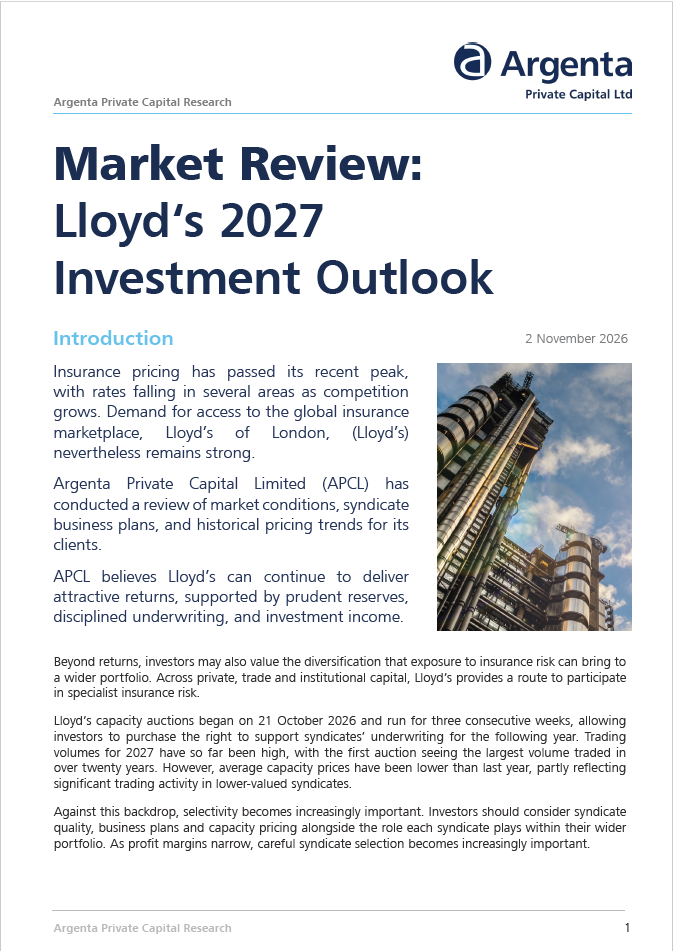
To assess the outlook for 2027, APCL Research analysed the Syndicate Business Forecasts of approximately 40 syndicates open to private capital, comparing their assumptions with historical results and knowledge of management personnel.
The findings point towards a softer market, however, the outlook is far from uniform.
Property (re)insurance has experienced some of the steepest pricing declines, while some syndicates see opportunities in areas including political risk, specialist reinsurance and delegated authority business. Cyber presents a particularly mixed picture, with syndicates taking markedly different approaches to growth and exposure as competition increases.
One important source of support is the strength of market reserves.
APCL Research finds that syndicates in its analysis hold more than £1.50 of additional reserve for every £1 of reported but unpaid claims. Lloyd’s has also reported more than £6.6 billion held above actuarial estimates.
This reserve strength may provide an important buffer against adverse claims development as underwriting conditions become more challenging. Investment income has also become a more important contributor to returns.
For investors, APCL believes the shift in market conditions increases the importance of balancing quality, price and diversification.
APCL’s analysis finds that its higher-rated syndicates have generally adopted more cautious assumptions in their 2027 plans, including less reliance on new business and lower assumed investment returns. By comparison, some lower-rated syndicates rely on stronger growth and more ambitious profit forecasts.
Cautious planning does not guarantee stronger performance, but it may provide greater protection if insurance rates fall faster than expected, investment returns disappoint, or claims increase.

The annual Lloyd’s capacity auctions remain an important part of portfolio construction for private capital investors, providing a market to buy and sell freehold syndicate capacity.
The 2027 auctions began on 21 October 2026. Trading volumes have been high so far, with the first auction recording the largest volume traded in more than 20 years. However, average capacity prices have been lower than the previous year, partly reflecting significant activity in lower-valued syndicates.
This reinforces the importance of considering capacity price alongside a syndicate's underlying quality, the realism of its business plan, and its role within a diversified Lloyd’s portfolio.
As pricing softens, APCL’s research suggests the Lloyd’s market can continue to offer opportunities, although greater selectivity is likely to become increasingly important.
Prudent reserves, disciplined underwriting and investment income can continue to support returns where syndicate plans are realistic, and management teams execute them effectively.
For 2027, APCL will continue to focus on building diversified portfolios and identifying opportunities across the market, while assessing relative value through the capacity auctions and selected new opportunities.
Download the full Market Review below for APCL Research’s analysis of market conditions, syndicate business plans, pricing trends and movements across individual classes of business.
This article is intended as an introduction to the research and does not constitute investment advice. Please refer to the full report for the applicable disclaimer and risk information
1 Lloyd’s, 2026 Half Year Results, 3 September 2026
2 APCL Research (2026), as at Q2 2026 based on APCL-advised portfolio for 2026
3 Lloyd's, 2026 Auction One results